
Searching the digitised Diary
In 2023, the Parson Woodforde Society's committee chose to use a generous bequest from the late David Case to fund the creation of a digital version of the Society's edition of the Diary. Since the original typed or word-processed files no longer existed, scanning the printed pages of the most recent editions was selected as the most practical approach.
Over the course of forty years, the seventeen volumes were gradually transcribed from the manuscript diaries. As the project progressed, editorial and aesthetic preferences changed. Some volumes used a variant of the Caslon typeface, designed by William Caslon in 1722, to create a period look.
William Caslon (1692/93 – 23 January 1766)
 William Caslon holding his typeface Specimen sheet, portrait by Francis Kyte (1710–1744) [public domain, via Wikimedia Commons]William Caslon was one of the most influential type designers of the 18th century. The Caslon typeface became famous for its clarity, balance, and readability. Caslon's fonts were widely used in books, newspapers, and important historical documents, and they shaped how printed language looked for generations.
James Woodforde would almost certainly have read books set in Caslon. The American Declaration of Independence, printed in Philadelphia, used Caslon Old Face type for its setting.
Because of this lasting influence, Caslon is often seen as a founder of modern typography and a key figure in the history of printing. His famous 'Specimen' sheet displays his many typefaces.
Caslon 'Discretionary' Ligatures
In writing and typography, a ligature is a single character formed by joining two or more letters together. The term comes from the Latin ligatus, meaning 'to tie or bind'.
The Caslon font variant used in the Diary volumes features two 'discretionary' ligatures: ct and st. These design elements originated from metal typecasting and were thought to enhance visual appeal and mimic handwriting. Unlike epigraphic ligatures found in languages such as Latin, Greek, and Sanskrit, these are purely typographic.
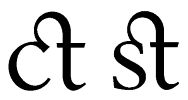
However, elegant as they may appear, they present a challenge for digital searching, as a careful researcher and Society member has discovered.
Using the Ctrl + F shortcut
In Windows, the Ctrl + F shortcut is a universal 'Find' command that allows you to search for specific text within a document open in a web browser. Holding down the Control (Ctrl) key and clicking on tapping the F key opens a small search bar or dialogue box. The Mac keyboard equivalent is Command + F.
As you enter a search term, the application searches the document for matching results, highlights them, displays how many there are, and allows navigation using the up or down arrows. This is a familiar procedure for most Windows users.
Searching for 'sister' and 'breakfasted'
While searching for 'Sister Clarke', the Society's researcher found that not all instances of 'sister' were found. He then tested the word 'breakfasted', frequently found in the Diary and containing the st ligature, to pinpoint the issue.
 James Woodforde's digitised Diary entry for 2 January 1780, with 'Sister' and 'Breakfasted' in variant Caslon font
He found that a Ctrl + F search in the 1780–1781 volume revealed 984 entries, but started at 6 January 1780, missing among others the first ten entries from the previous five days. There seemed to be no clear reason for this, as the text looked identical in every entry. The issue was found in the 1780–1781 volume, printed in Caslon font, where the digitised st ligature did not produce reliable results. As part of his ongoing investigation, he replaced 'breakfasted' with 'breakfafted', given that the ft letter combination is similar to the st ligature. This revised search yielded an additional 350 instances of 'breakfasted'.
He recommends minimising redundant searches by entering only part of the word, ensuring that the 'Whole Words' option remains deselected and excluding the st ligature. For example, using 'breakfa' will return all instances of 'breakfasted' as well as the infrequent occurrence of 'breakfast'.
When a ligature appears in the middle of a word like 'sister' or 'Weston', searching becomes difficult due to insufficient preceding or following letters. The same issue arises with the word 'Frost', making weather information searches challenging. Where possible, it is preferable to avoid a longer search phrase such as 'Sister Clarke', and simply search 'Clarke'.
Searching for 'respectable'
When searching for the term 'respectable', potential problems arise due to the presence of the ct ligature. Our researcher was unable to identify a suitable replacement, although substituting ft occasionally yielded results. Initiating a search with 'respe' may be a more effective approach.
 James Woodforde's digitised Diary entry for 4 February 1780, with 'respectable' in variant Caslon font
Searches for words or phrases without the ct or st ligatures seem unaffected. Woodforde is known among readers of the Diary for his fainting episodes, and during his final four years he often described the impact of his ailments using the term 'faint'. From the start of the Diary to 1797, the word is used 23 times. From 1798 to 1802, as his health worsened, it appears in 80 entries. This count seems accurate.
The volumes which are rendered in the Caslon font
While the discretionary ct and st ligatures may cause issues with certain words, most text in these volumes remains readily searchable using Ctrl + F. The volumes affected are as follows:
1766–1768; 1778–1779; 1780–1781; 1788–1790; 1791–1793; 1794–1795; 1796–1797; 1798–1800; 1801–1802
Other digital searching issues
Search algorithms often fail to recognise 18th-century textual conventions, especially superscript forms. As a result, terms like Mr and Mrs are frequently overlooked. Furthermore, Woodforde had his own shorthand, and he was not always consistent in his usage. An investigation into the term 'land tax' was complicated by Woodforde's use on some occasions of the hyphenated form 'Land-Tax', and a search of the 1791–1793 volume reveals three variants for All Saints' Church at Weston: 'Weston Church'; 'Weston-Church'; and 'Weston Ch:'
Our researcher concluded that searches of the digitised Diary can offer significant benefits. However, caution is advised, as certain letter combinations in some volumes may present challenges. Therefore, results from such searches should not be considered entirely reliable.